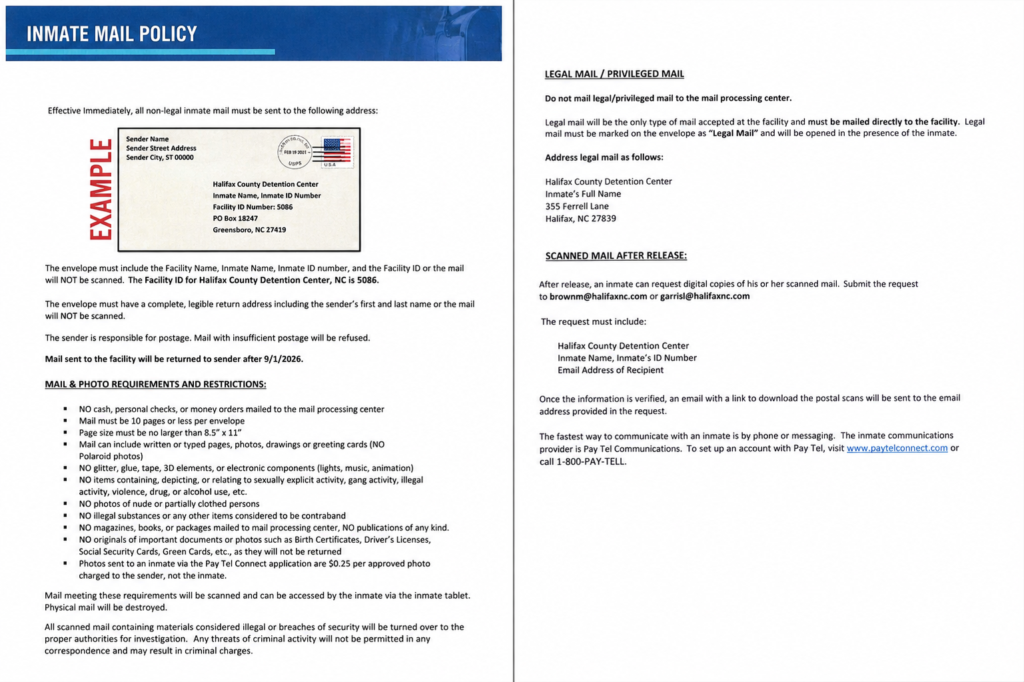
HCSO Detention Mail Policy
The Halifax County Detention Center will change the way inmates receive personal mail beginning Sept. 1, with correspondence being sent to an off-site processing center and delivered electronically to inmates.
Detention Center Administrator Maj. Michael Brown said the change was prompted by concerns over contraband entering the facility through the mail.
“This is due to contraband being mailed into the facility, which relates directly to the safety and security of those that are currently in our custody,” Brown said. “It is also a safety concern for the staff that are employed by the Halifax County Sheriff’s Office and Detention Center.”
Under the new policy, non-legal mail will no longer be mailed directly to the detention center. Instead, correspondence must be sent to a mail processing center in Greensboro operated by Pay Tel Communications.
Brown clarified that although the policy distributed by the Sheriff’s Office states “effective immediately,” the change does not actually take effect until Sept. 1.
“I can see where the confusion lies with the Facebook post,” Brown said. “The new policy doesn’t take effect until September 1, 2026. That being said, we wanted to alert the citizens and make them aware of the new change.”
Beginning Sept. 1, personal mail sent directly to the detention center will be returned to the sender.
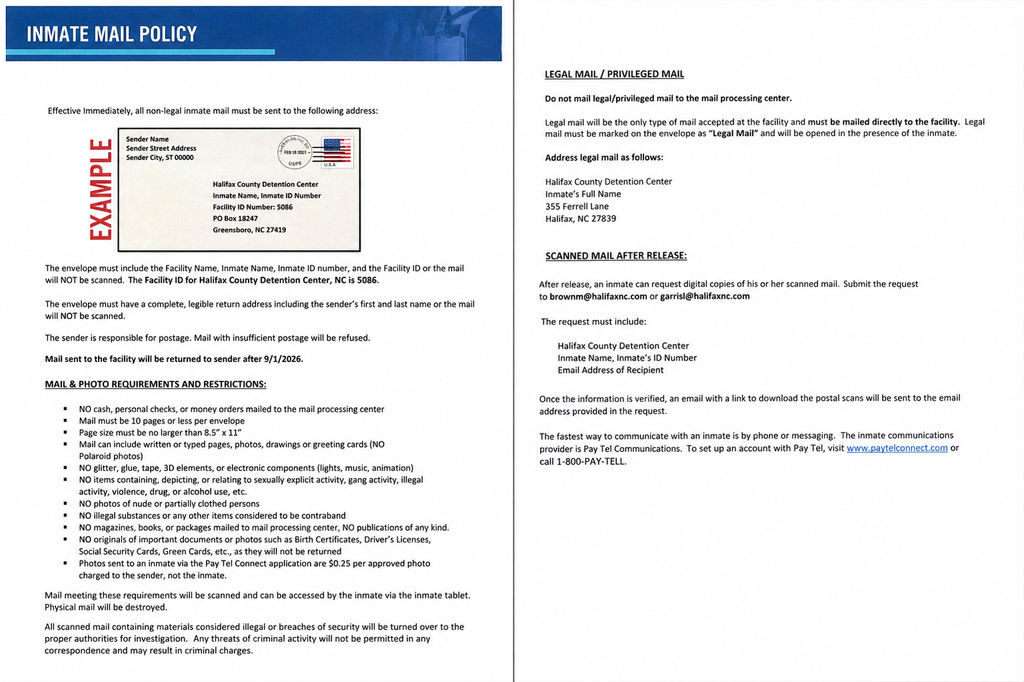
How personal mail must be addressed
Beginning Sept. 1, non-legal inmate mail should be addressed to:
Halifax County Detention Center
Inmate Name, Inmate ID Number
Facility ID Number: 5086
PO Box 18247
Greensboro, NC 27419
The envelope must include the facility name, inmate’s name and ID number, and facility ID number or the mail will not be scanned. A complete and legible return address, including the sender’s first and last name, is also required.
Mail that meets the requirements will be scanned at the processing center and made available electronically to the inmate. The original physical mail will then be destroyed.
Brown said Pay Tel provides the mail-processing service at no additional cost to Halifax County. Inmates are also not charged to access and read their scanned mail.
Each inmate has access to tablets on which the correspondence can be viewed, according to Brown. If a tablet is unavailable, each housing unit has a stand-alone kiosk inmates can use.
Restrictions on mail and photographs
Under the new policy, mail is limited to 10 pages or fewer per envelope, with pages no larger than 8.5 by 11 inches.
Written or typed pages, photographs, drawings and greeting cards are permitted, although Polaroid photographs are prohibited.
The policy also prohibits cash, personal checks and money orders from being sent to the processing center. Glitter, glue, tape, three-dimensional elements and electronic components are prohibited, as are magazines, books, packages and other publications.
Originals of important documents or photographs, including birth certificates, driver’s licenses, Social Security cards and green cards, should not be mailed because they will not be returned.
The policy also prohibits material containing or depicting sexually explicit activity, gang activity, illegal activity, violence, drug or alcohol use, nude or partially clothed people, illegal substances or other items considered contraband.
The Sheriff’s Office said scanned correspondence containing illegal material or security threats will be turned over to the appropriate authorities for investigation.
Legal mail remains different
The change does not apply to legal or privileged mail.
Legal mail should not be sent to the Greensboro processing center and will continue to be accepted directly at the detention center. It must be marked “Legal Mail” and will be opened in the presence of the inmate.
Legal mail should be addressed to:
Halifax County Detention Center
Inmate’s Full Name
355 Ferrell Lane
Halifax, NC 27839
Accessing scanned mail after release
Former inmates may request digital copies of scanned mail after their release.
Requests can be submitted to brownm@halifaxnc.com or garrisl@halifaxnc.com and must include the Halifax County Detention Center name, the inmate’s name and ID number, and the email address where the correspondence should be sent.
Once the information is verified, the former inmate will receive an email containing a link to download the scanned correspondence.
The detention center also notes that inmates can communicate by telephone or messaging through Pay Tel Communications.