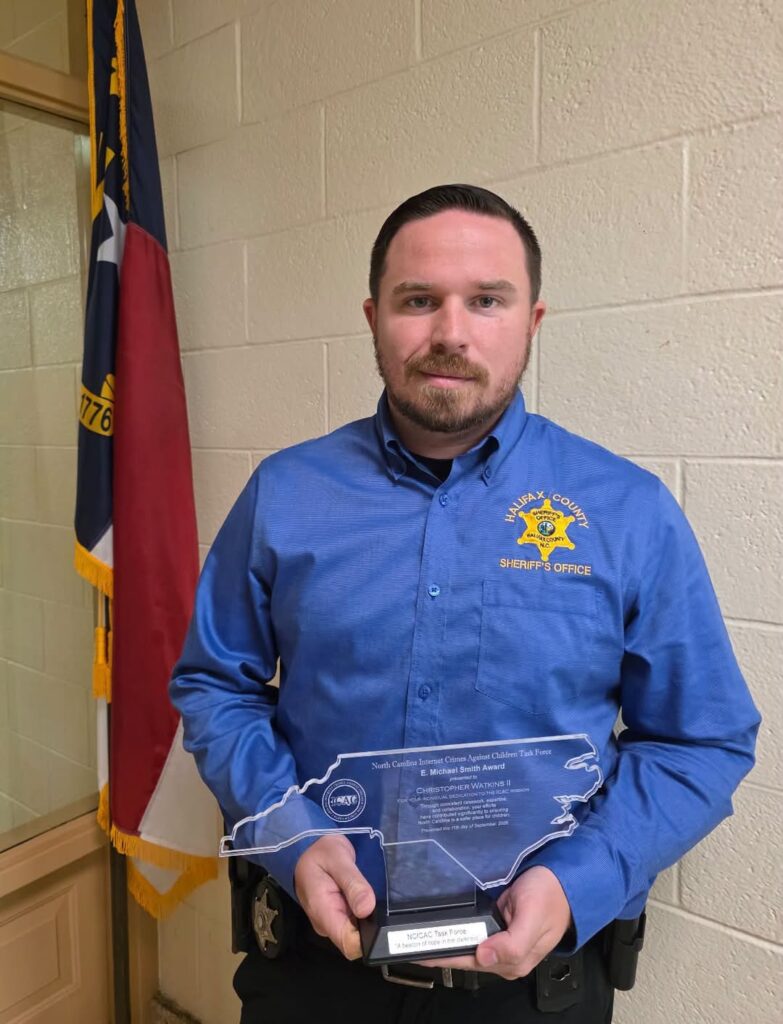
HALIFAX COUNTY, N.C. — Halifax County Sheriff’s Office Detective Sergeant Christopher Watkins has received a statewide award recognizing his investigative work and leadership in combating internet crimes against children.
Watkins received the E. Michael Smith Award during the North Carolina Internet Crimes Against Children Task Force’s fall conference, held Sept. 10-11 in Lake Junaluska.
The award carries an added distinction because a recipient does not have to be selected.
According to information provided to the Roanoke Valley Reporter by Public Information Director Chad Flowers with the North Carolina State Bureau of Investigation, a committee receives and reviews nominations for awards. The E. Michael Smith Award may be presented when a particular investigator stands out among the nominees and receives near-unanimous support from the committee.
If no investigator meets that standard, the award does not have to be presented.
In Watkins’ case, the committee determined his performance warranted the recognition.
From Criminal Investigations to ICAC
Watkins joined the Halifax County Sheriff’s Office in December 2022 after previously serving for a total of five years with two law enforcement agencies in Virginia.
He has worked in the Sheriff’s Office Criminal Investigations Division since September 2023 and began working Internet Crimes Against Children investigations in February 2024.
Watkins holds an Advanced Law Enforcement Certificate through the North Carolina Sheriffs’ Education and Training Standards Commission and a master’s degree in criminal justice from Colorado Technical University.
Within the North Carolina ICAC Task Force, Watkins serves as both an investigator and canine handler.
His specialized training includes Interdiction for the Protection of Children, Sexual Assault Investigations, Introduction to Internet Crimes Against Children, Peer-to-Peer Investigations, Undercover Chat Operations and multiple digital forensics courses.
According to the Sheriff’s Office, Watkins began conducting ICAC investigations with limited access to software normally used to examine electronic devices in these cases. As a result, much of his examination of devices had to be performed manually rather than through software that could accelerate the process.
Watkins has also located and secured funding for equipment needed to investigate ICAC cases and pursued additional training to expand the types of investigations the Sheriff’s Office is capable of conducting.
His efforts also led to the Sheriff’s Office obtaining K9 Cypher, an electronic storage detection canine trained to locate electronic devices that may be concealed during investigations.
Watkins and Cypher have since assisted with dozens of search warrants around North Carolina in support of other agencies participating in the NC ICAC Task Force. Watkins has also assisted Homeland Security Investigations with search warrants in North Carolina, according to the Sheriff’s Office.
Investigations Lead to State and Federal Cases
The Sheriff’s Office identified State v. Pestano as one of Watkins’ notable publicly disclosed ICAC investigations.
According to the Sheriff’s Office, Pestano was a teacher at Halifax County Early College and became the first offender arrested as a result of an ICAC investigation handled by Watkins after he began working those cases.
Another investigation cited by the Sheriff’s Office was State v. Skipper. That case was adopted by Homeland Security Investigations and ultimately prosecuted federally.
“Now It’s My Turn”
Watkins said investigating Internet Crimes Against Children was not something he originally expected to do during his law enforcement career.
“Working Internet Crimes Against Children is not something that I thought that I would ever work,” Watkins said. “When I was assigned the ICAC case load, I didn’t realize what all would be asked of me nor did I understand the toll that working these cases can bring.”
After working the cases for more than two years, Watkins said his understanding of the scope of crimes targeting children online has changed.
“I have learned over the last couple of years that the issue with Internet Crimes Against Children is much worse than I thought that it was originally,” Watkins said.
He also reflected on the investigators who performed the work before him.
“I have seen the work done by other investigators over the years and I was always happy that they were able to locate, prosecute, and put away those offenders,” Watkins said. “Now it’s my turn to pick up where they left off.”
Watkins said working with K9 Cypher has also helped him cope with some of the mental strain associated with investigating crimes involving children.
“I believe that being able to work a canine that is trained to assist in locating hidden devices that are commonly used in these types of cases has helped with the mental strain that comes with working these cases,” Watkins said. “K9 Cypher has been instrumental in keeping me motivated day to day.”
Watkins also urged parents and family members to remain aware of what children are doing online and who they are communicating with.
“With the advancement of technology, there are more ways for these offenders to reach our children, but we have to stay vigilant in locating these offenders and preventing our children from being victims,” Watkins said.
He noted that applications that appear to be innocent communication platforms can also be used by offenders attempting to contact children.
“I believe that it is up to the parents and family members to keep a closer eye on what their children are doing and who they are talking to,” Watkins said.
The E. Michael Smith Award
The award Watkins received is named in honor of E. Michael “Mike” Smith, a former SBI agent who spent much of his career with the agency’s Computer Crimes Unit.
Smith wrote North Carolina’s first Internet Crimes Against Children grant proposal in 1998, before the SBI’s Computer Crimes Unit had been established. At the time, Smith was the SBI’s first and only ICAC investigator and worked cases across North Carolina.
As additional agents joined the newly formed Computer Crimes Unit, Smith helped train a generation of ICAC investigators. He became known for his expertise in investigations and computer forensics and served as a resource for other investigators working those cases.
The E. Michael Smith Award honors that legacy by recognizing investigative excellence and leadership within the North Carolina Internet Crimes Against Children Task Force.