Local resident Jim Garrett’s frequent social media posts about crime, neglected properties, and quality-of-life issues in Roanoke Rapids can get annoying. I’ll be the first to admit that I have snoozed his posts on my Facebook feed more than once because of the distraction they cause for me.
But being annoying doesn’t necessarily mean being wrong.
And when it comes to many of the problems Garrett continues to point out in Roanoke Rapids, he isn’t wrong. He actually has a valid point.
Whether he realizes it or not, much of what Garrett is asking the city to address closely resembles a policing philosophy that has been discussed and used across the United States for decades.
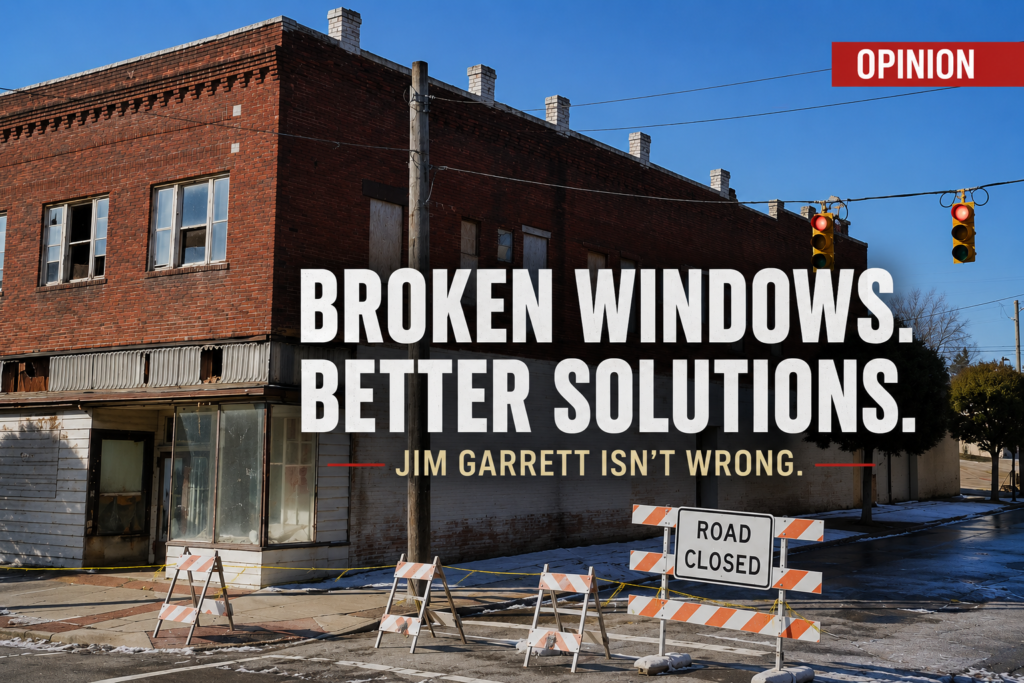
It is called “broken windows” policing.
The theory comes from a 1982 article published in The Atlantic Monthly by George Kelling and James Wilson.
The basic idea is fairly simple: When visible disorder is allowed to remain in a neighborhood, it sends a message that nobody is paying attention and nobody is really in control.
The name comes from the example of a building with a broken window. One window gets broken and nobody fixes it. Eventually another gets broken. Then another. Before long, the condition of the property sends the message that nobody cares what happens there.
The same idea can apply to a neighborhood.
An abandoned property sits untouched. Trash accumulates. Graffiti isn’t removed. Public drinking becomes common. Drug activity becomes more visible. People begin avoiding the area. Residents become less willing to get involved, and behavior that once would not have been accepted slowly becomes normal.
That is the basic idea behind broken windows.
And when Garrett argues that some version of that is happening in Roanoke Rapids, I think he is absolutely correct.
Too many things are overlooked by the various agencies responsible for dealing with crime, property conditions and quality-of-life problems. One problem is ignored because it doesn’t seem serious enough or there is a lack of manpower to address it. Then another is ignored. Eventually everyone becomes accustomed to seeing conditions that should never have been allowed to become normal in the first place.
Where Garrett and I begin to part ways is over what should be done about it.
From many of his posts, Garrett appears to favor something much closer to a zero-tolerance approach: Find the violation, enforce the law and continue doing it aggressively until the problem disappears.
Broken windows and zero tolerance, however, are not the same thing.
Kelling and Wilson’s original theory put considerable emphasis on foot patrols, officer discretion, maintaining public order and officers actually knowing the neighborhoods they work in.
That last part matters.
An officer who knows a neighborhood also knows its people. He knows what is normal there, what isn’t, who is causing problems and who may simply need somebody to tell them to clean something up before the city starts writing citations or making arrests.
That is much different from driving into a neighborhood and deciding everyone is getting a ticket because the city has suddenly decided it has had enough.
There is evidence that efforts aimed at specific problem areas and public nuisances can work. What has not been convincingly proven is the idea that aggressively enforcing every minor offense will automatically cause serious crime to decline.
New York City is probably the most famous example used in this debate. Violent crime dropped dramatically while the city was using policing strategies associated with broken windows.
The problem with giving broken windows all the credit is that violent crime was dropping across much of the country at the same time, including in cities that weren’t using New York’s approach.
There is also another problem with zero tolerance that becomes particularly important here in Roanoke Rapids.
You need the people who actually live in these neighborhoods.
Whether we are talking about downtown around Madison and Monroe streets, Becker Farms, Chaloner Park or anywhere else in the city, police officers, code enforcement officers, and city employees cannot be everywhere all the time.
The people who live there know far more about what is happening on their street every day than City Hall ever will.
If you enter those neighborhoods with the attitude that everyone is a problem that needs to be cited, arrested or punished, you are going to lose the cooperation of many of the very people you need to help improve them.
People become defensive. They stop cooperating. They stop calling. They stop talking to officers. Instead of viewing the city and police as partners trying to improve their neighborhood, they begin viewing them as another problem or enemy.
That accomplishes nothing.
It is also why Roanoke Rapids cannot solve these problems with a one-size-fits-all approach.
Every neighborhood is different, and every property owner is different.
Take an overgrown property as a simple example.
One property owner may be perfectly capable of maintaining the property and simply refuses to do it. Another may be an elderly resident physically unable to cut the grass. Another property may belong to someone who died and left behind a tangled estate where nobody even knows who is responsible for maintaining it.
Those situations may look exactly the same from the street, butthey shouldn’t necessarily be handled exactly the same way.
The first property owner may eventually need a citation. The elderly resident may need help. The abandoned property may require an entirely different legal process.
The goal should be fixing the problem, not seeing how many citations the city can write or lawsuits they can initiate.
That doesn’t mean enforcement shouldn’t happen.
There comes a point when warnings have been ignored, opportunities to voluntarily correct a problem have been refused and enforcement becomes necessary. When that happens, the city should enforce its ordinances and the police should enforce the law.
But enforcement should be a tool used to accomplish the goal. It shouldn’t become the goal itself.
Roanoke Rapids doesn’t have to choose between continuing to ignore these problems and declaring war on every minor violation in the city. Those aren’t the only two choices.
Police can know the neighborhoods they patrol. Code enforcement can work with property owners before immediately reaching for a citation. Public Works can address problems that fall within its responsibility. The city can identify properties and locations generating repeated problems and concentrate resources there. Residents can be brought into the process instead of treated as the target of it.
And when someone simply refuses to cooperate after being given a reasonable opportunity to do so, then enforce the law.
That is where I think Garrett has started an important conversation.
He is right that Roanoke Rapids has allowed too many problems to become normal. He is right that ignoring small problems doesn’t make them disappear. And he is right that the city needs to become more proactive about addressing them.
Where I disagree with him is the belief that aggressive enforcement across the board is the answer.
The broken-windows theory contains a lesson worth considering nearly 45 years after Kelling and Wilson first wrote about it.
When a window gets broken and stays broken, somebody eventually needs to fix it.
Roanoke Rapids has too many broken windows — some literal and many figurative — that have been allowed to remain broken for too long.
Jim Garrett is right about that.
Where we disagree is how we fix them.