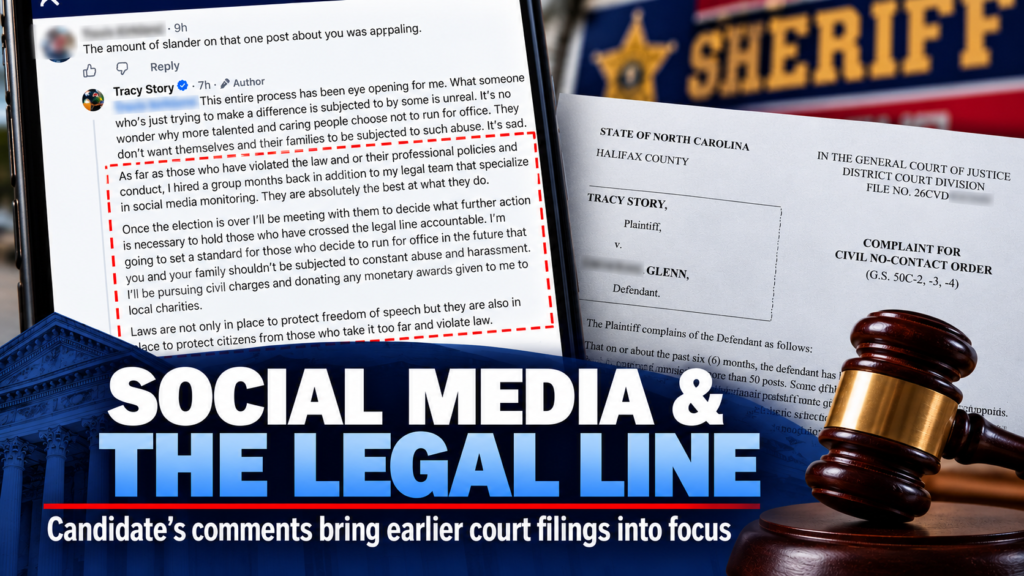
HALIFAX COUNTY — A candidate for Halifax County sheriff says he has hired a group specializing in social media monitoring and plans to consult with the group and his legal team after the election about possible action against people he believes have crossed “the legal line.”
The comments by Tracy Story have also brought renewed attention to two civil no-contact complaints he filed earlier this year against a Roanoke Rapids husband and wife over alleged social media activity.
Story made the comments Oct. 2 while responding to a supporter on Facebook.
Story had posted a lengthy campaign message discussing experience in public office and arguing that years of experience do not necessarily translate into successful leadership.
In the comments, the commenter wrote, “The amount of slander on that one post about you was appaling.”
Story responded that the campaign had been “eye opening” and said he and his family had been subjected to what he described as abuse.
“I hired a group months back in addition to my legal team that specialize in social media monitoring,” Story wrote. “They are absolutely the best at what they do.”
Story said he plans to meet with the group and his legal team after the election.
“Once the election is over I’ll be meeting with them to decide what further action is necessary to hold those who have crossed the legal line accountable,” Story wrote.
He also said he would be “pursuing civil charges” and would donate any monetary awards to local charities.
“Laws are not only in place to protect freedom of speech but they are also in place to protect citizens from those who take it too far and violate law,” Story wrote.
Earlier Court Filings
Story’s comments prompted Laura Glenn to publicly discuss two civil no-contact complaints Story filed earlier this year against her and her husband, Mathew Glenn.
Court records obtained by the Roanoke Valley Reporter show Story filed separate Chapter 50C complaints against the Glenns in Halifax County District Court on March 25.
In the complaint against Laura Glenn, Story alleged she had harassed him through social media during the previous six months by making more than 50 posts.
Story alleged the posts antagonized him and his family, encouraged others to participate and resulted in reputational, mental and financial damages. He also alleged some of the posts were threatening.
Story made substantially similar allegations in the complaint against Mathew Glenn.
In both cases, Story requested temporary no-contact orders and indicated that he ultimately wanted permanent no-contact orders. Among the restrictions requested were orders prohibiting stalking, harassment and contact by telephone, written communication or electronic means.
Judge Declined Immediate Orders
District Court Judge W. Rob Lewis II declined to issue the requested immediate orders.
In Laura Glenn’s case, Lewis wrote that the court was denying entry of an ex parte order but would set the matter for a full hearing on March 30.
Lewis similarly denied ex parte relief in the case involving Mathew Glenn and scheduled it for a full hearing on the same date.
The Halifax County Clerk of Superior Court’s Office confirmed to RVR that Story subsequently voluntarily dismissed both cases.
Review of Social Media Posts
RVR reviewed publicly available posts on Laura Glenn’s Facebook page from the period referenced in Story’s complaint.
RVR did not locate a publicly available post from that period identifying Story by name.
A Dec. 13, 2025, post criticized an unnamed individual’s law enforcement background and later referred to that individual “running” for office, but did not identify Story by name.
Other publicly available posts reviewed by RVR discussed topics including infidelity but similarly did not identify Story by name.
The current availability of the Facebook posts does not establish what material may have existed when Story filed his complaint in March or whether posts were subsequently deleted, hidden or otherwise made unavailable.
Story’s complaint did not identify the alleged 50-plus posts individually.
Glenn Questions Use of Courts
Following Story’s recent comments about his legal team and social media monitoring, Laura Glenn questioned what his approach to criticism could mean if he were elected sheriff.
“I don’t think citizens should have to calculate the likelihood of being served with court papers before criticizing a candidate or public official,” Glenn wrote.
Glenn argued that criticism does not become unlawful simply because it is persistent, embarrassing or inconvenient.
She also wrote that citizens should not be intimidated out of speaking about people seeking public office.
New Appeals Court Decision Addresses Political Social Media Posts
Several weeks after Story’s March court filings, the North Carolina Court of Appeals issued a published decision addressing Chapter 50C no-contact orders involving online criticism of a political candidate.
In Coble v. Ballentine, decided April 15, the Court of Appeals reversed a civil no-contact order that had been entered against a man who created a Facebook page and website opposing Beverly Coble’s announced candidacy for mayor of Randleman.
The appellate court focused on whether the online material was directed at Coble or was instead commentary about her intended for others.
The court concluded that the posts and articles were about Coble but were not directed to her. It also noted that the stated purpose of the publications was to assist voters in evaluating her candidacy.
Because the evidence did not establish that the online publications were directed at Coble as required under the applicable harassment provisions, the Court of Appeals reversed the no-contact order.
The court did not decide the defendant’s separate First Amendment argument because it concluded the conduct did not meet the statutory requirements for the no-contact order.
The Coble decision was issued after Story filed and voluntarily dismissed his complaints against the Glenns and therefore was not available when Story initiated those proceedings.
Story Asked to Respond
RVR contacted Story through his publicly available campaign email and asked what prompted him to hire a social media monitoring group, what conduct he believes has crossed “the legal line,” and whether his previous complaints against the Glenns were related to the conduct referenced in his recent Facebook comments.
RVR also asked Story to identify the more than 50 social media posts referenced in his complaint against Laura Glenn and whether he could provide copies or screenshots of the posts he alleged were threatening.
Story was also asked why he voluntarily dismissed the two complaints after the court declined to issue immediate no-contact orders and scheduled the cases for full hearings, and where he draws the line between criticism of a political candidate and conduct he believes warrants legal action.
Story did not respond to RVR’s initial request for comment. A second request was sent Wednesday. As of publication, Story had not responded.