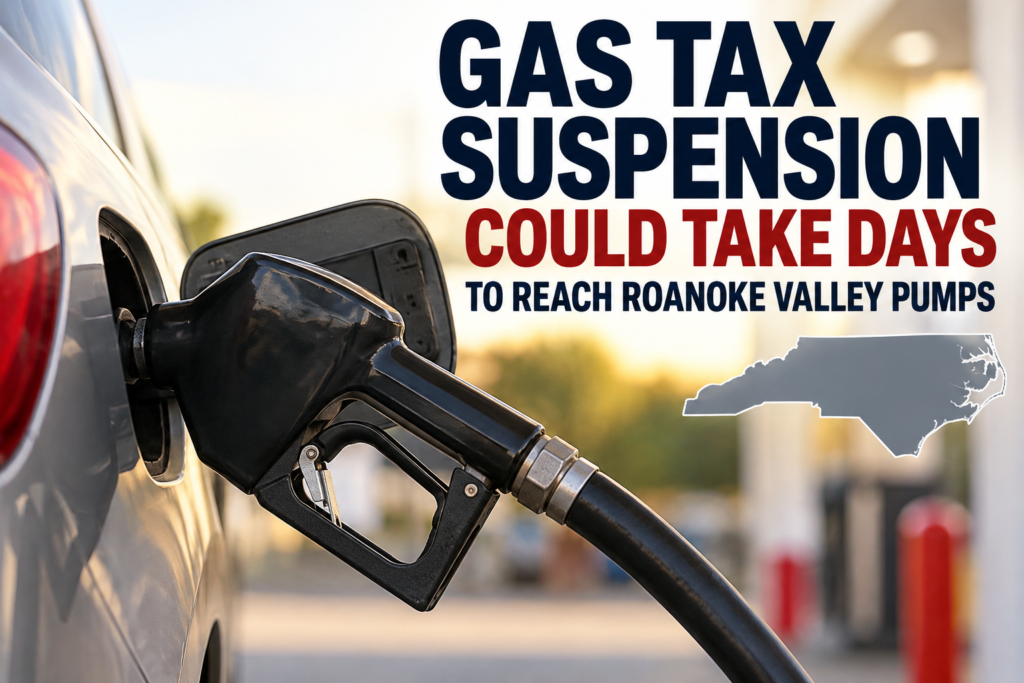
North Carolina lawmakers have voted to temporarily eliminate the state’s 41-cent-per-gallon motor fuels tax, but Roanoke Valley motorists should not necessarily expect to see prices drop by 41 cents overnight if the measure becomes law.
House Bill 3, which was ratified by the General Assembly Wednesday and sent to Gov. Josh Stein, would reduce the state’s motor fuels tax to zero beginning the day after the bill becomes law and continuing through Nov. 30.
The legislation specifically requires the savings from the suspended tax to ultimately be reflected in the price paid by consumers. However, it also contains an important exception for fuel already purchased before the suspension takes effect.
Under the bill, retailers are not required to reduce the price of fuel when their cost still includes motor fuels taxes that accrued before the suspension began.
For New Dixie Oil Corp., one of the Roanoke Valley’s largest fuel distributors and convenience store operators, working through that existing inventory could take anywhere from several days to nearly three weeks.
“Each site varies and each grade varies,” New Dixie Oil President T. Scott Aman told the Roanoke Valley Reporter. “Inventory may take 3 to 20 days to turn. Again, this will be hard to manage.”
Aman said the timing of any reduction would depend in part on whether retailers receive some type of credit for taxes already paid on existing inventory. If not, stations would have to work through fuel purchased at the higher, taxed cost before replacing it with fuel purchased during the tax suspension.
“This will be a mess,” Aman said.
Don’t Necessarily Expect Exactly 41 Cents
Even once tax-free fuel begins reaching local stations, motorists may not see a clean 41-cent difference between one day’s pump price and the next.
Aman said wholesale fuel costs are constantly changing — sometimes by 5, 10 or even more than 20 cents per gallon in a single day.
Asked whether New Dixie customers should expect the full tax suspension to ultimately be reflected in the company’s prices, Aman said yes if the underlying cost of fuel remained unchanged.
However, that cost rarely stays still.
“The pump price is a factor of cost and a factor of competition,” Aman said.
He said New Dixie’s intention is to remain competitive in each market where it operates while selling branded, top-tier fuels.
That means a simultaneous increase in wholesale fuel prices could offset part of the visible 41-cent tax reduction at the pump. Likewise, a decrease in wholesale costs could result in a larger overall price decline.
How the Tax Gets Into the Price
Unlike a traditional retail sales tax added to a customer’s purchase at the register, the motor fuels tax is already incorporated into the cost of gasoline before motorists ever pull up to the pump.
Aman said fuel taxes are applied to New Dixie’s invoices from its supplier when fuel is loaded at the terminal. That cost is then incorporated into fuel sold and delivered to retail, farm, commercial and other customers.
That process is also why existing inventory matters.
Fuel already sitting in a station’s tanks when the suspension begins was purchased at a cost that included the state tax. House Bill 3 specifically protects retailers from having to immediately reduce the price of that previously taxed inventory.
Once the suspension takes effect, however, the bill says the cost of newly untaxed motor fuel is not to include the suspended tax so that the ultimate price paid by consumers reflects the savings.
Aman Questions the Temporary Suspension
Aman said lower fuel prices are good for both consumers and his business.
High prices increase credit card fees and inventory carrying costs for fuel retailers while generally reducing the number of gallons sold, he said.
But Aman questioned whether temporarily eliminating the tax is the best way to achieve lower prices.
“We all badly need fuel prices to go back down,” Aman said. “But not like this … this is simply a political move that makes it hard to handle for a short period of time.”
Aman also raised concerns about the loss of revenue normally generated by the motor fuels tax, which helps fund transportation needs.
House Bill 3 addresses that loss by directing the state to transfer money from the Stabilization and Inflation Reserve to replace revenue that otherwise would have gone to the Highway Fund, Highway Trust Fund and several other accounts during the suspension.
If signed by Stein, the suspension would begin the following day and remain in effect through Nov. 30.